

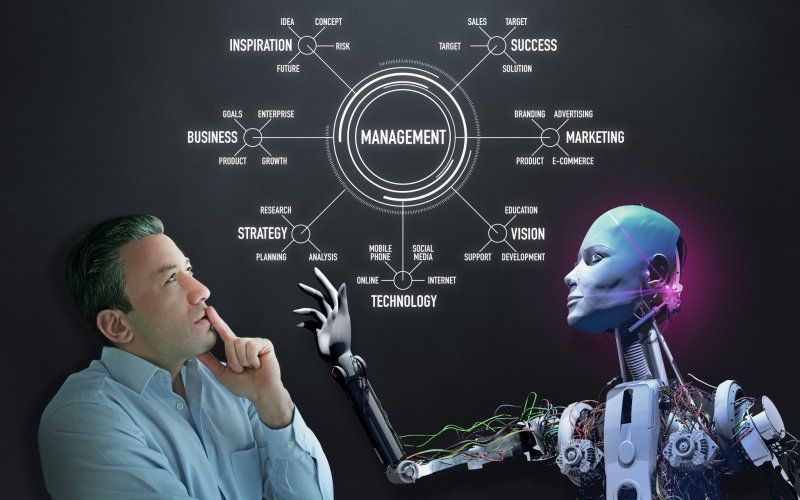
“Curiosity has its own...

March 29, 2023

Share this article:

...reason for existing."


The title of this month's article is actually the second half of an Albert Einstein quote that reads, "The important thing is not to stop questioning. Curiosity has its own reason for existing." We introduced thinking differently as a lead-in to innovation last month which we also know is a function of curiosity. As we continue our conversation around diversity of thought, we will speak directly to the importance of critical thinking. Even now, as the conversation around Open AI and ChatGPT ramp up to a fever pitch, the need for leaders to understand the importance of critical thinking has never been more crucial!

We define critical thinking as, "A process where leaders question their own assumptions, as well as those of others, using a mix of research, analysis, questioning and exploring new ideas to inform in a way not restricted by subjective perspectives of peers and/or the status quo." In this month's discussion, we will address the first four of eight critical thinking skills identified by Zety writer Michael Tomaszewski earlier this year. These four skills focus primarily on what critical thinking skills the leader needs to effectively make decisions based on their own critical thinking.

  • Analysis: The ability of the leader to collect and process information and knowledge is a crucial first step in effective critical thinking. The important attitudinal element of analysis is that it is a continuous process. In a VUCA (Volatile, Uncertain, Complex, Ambiguous) business environment, thinking that decisions are based on static events can end up being a fool’s errand. Effective analysis is an ongoing process where the leader is constantly gathering new information either based on new events or simply to continue validating the information they have on current events. The easiest way we’ve used in our own experience is taking Albert Einstein’s words to heart and never stop questioning!


  • Interpretation: The ability of the leader to conclude the meaning of processed information they have available to them becomes the next import critical thinking skill. In our coaching practice, we often refer to the DIKW (Data, Information, Knowledge, Wisdom) Cycle when facilitating or coaching around effective communications. The DIKW Cycle helps leaders fully appreciate the difference between content and context. For instance, it is common information that a tomato is a fruit. However, knowledge prevents us from putting a tomato in a fruit salad. Similarly, leaders know that information by itself (financial reports, operational reports, etc.) have limited value until their meaning is fully understood!


  • Inference: Now the leader must assess whether the knowledge they have is sufficient and reliable to support their decision-making process. Here is where the leader’s decision-making and decision risk come into play. One of the best pieces of advice as a young executive was from my then leader who advised me to make my best B+ decisions. His meaning was that we had to acknowledge that there would rarely, if ever, be a time when leaders have all the information needed for an A+ decision. Rather, understand when there is enough information to make the decision and acknowledge that forward progress on a B+ decision where other information would follow is better than no progress waiting for the perfect decision!


  • Evaluation: Having information available to the leader still necessitates that they have the ability to make decisions based on the available information. Being a Leonardo de Vinci fan, there is an expression attributed to him that says, “Knowing is not enough; we must apply. Being willing is not enough; we must do.” Hiding behind fear of making the wrong decision or fear of not having enough information for the safest decision is no excuse for not making the leadership decision to move forward. Action is the way forward for any leader and being able to take the newfound knowledge and decide is the action their followers are expecting!


These first four critical thinking skills focus on the leader’s ability to formulate and decide what is the best way forward. They outline key activities that inform the decisions leaders make each and every day in a VUCA business environment. Certainly, there is a role to play for AI-informed technologies. However, the leader leverages these technologies to make very human decisions!


How are you leveraging critical thinking to support your business decisions? If you’re not sure, we can help.


Lead Well!

Follow Us:

Our Latest Insights

How are you leveraging AI to differentiate your business?
By Rick Lochner • September 28, 2026
...so that you can do something about it now”

By Rick Lochner • August 26, 2026
...it’s the product of their interaction.” While we’ve written intermittently about systems and processes, the current VUCA (Volatile, Uncertain, Comple, Ambiguous) business environment compels us to spend more time on how important systems thinking is to effective leadership. We are using the title quote from the late Russell Ackoff , who was a pioneer in the field of operations research, systems thinking and management science. And to illustrate the importance of the title quote, we will use a case study we came across a year ago to drive the point home. The project was a joint venture between General Motors and Toyota named the New United Motor manufacturing, Inc. or NUMMI for short. The goal of the venture was to apply the lessons Toyota learned around lean manufacturing to a failing GM plant in Fremont, California. The results were dramatic in the increased productivity of the plant proving that transformation could occur with fundamentally the same personnel in the plant before and after the switch. While the application of lean methodologies succeeded in producing much improved results, the lessons learned were ultimately lost on GM leadership. They concluded that it was the processes alone that created the change since the personnel were basically the same. In fact, it was the interrelationships between the processes that carried the success of the venture overall. Today, that plant is owned by Tesla. So, what does that mean in a VUCA business environment? It means that leaders trying to react and flex to pieces and parts of the system that are impacted by change will struggle to solve the problem in a sustainable way. It is understanding that volatility and/or complexity, while deeply affecting one particular part of the system, ultimately has systemic impacts across other systems as well. It also means that uncertainty and/or ambiguity will make it difficult to ascertain where the solution lies without looking at the business through the lens of systems thinking. Now, just for the fun of it, let’s throw in the impact of artificial intelligence (AI). The AI impact has come at the business environment with a vengeance to the point where we are already seeing the strategic and systemic challenges encountered by early adopters. In our estimation, it once again looks like business leaders are adopting AI as a workforce replacement instead of addressing where AI fits into the current and desired systems approach to the business. Once again, the absence of being able to see the interrelationships between systems creates major blind spots and lessons not learned similar to the NUMMI and GM venture. From our 2022 book, “ Finding the Missing Piece : The Impact of Effective Communications on sustainable Success”, we define systems thinking as, “...a holistic approach focusing on how a system’s components work together, how a system operates over time as well as how it operates in the context of other larger systems.” The only way systems can provide the foundational value to the organization is through leaders who can fully appreciate and understand its benefits, especially in a VUCA business environment! How are your leadership interactions enhancing the business systems? If you’re not sure, we can help . Lead Well!
Green road signs labeled “LEADER” left and “FOLLOWER” right on a pole
By Rick Lochner • July 26, 2026
This is a question every leader of any business (for profit or non-profit) of any size and any industry or market needs to regularly ask themselves. It is a critical question in that it establishes the very reason a leader earns the privilege of being called a leader.