
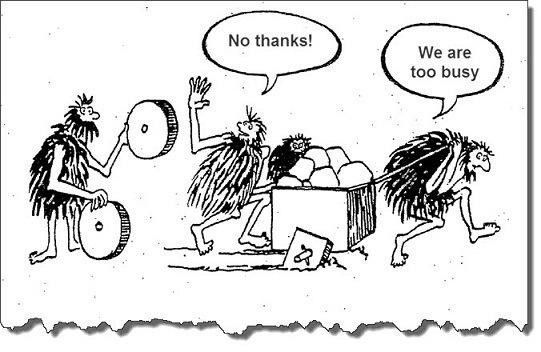
“There is nothing so useless…

October 28, 2014

Share this article:

Cartoon of two shaggy figures with a cart of eggs saying “No thanks!” and “We are too busy” to a drummer.

…as doing efficiently what should not be done at all.”


I spend a good bit of time in my practice working with businesses on their business planning and people development initiatives. A few of these clients have also invested their time in what is likely the least appreciated part of achieving sustainable success in business ~ process improvement! Peter Drucker’s quote above is a reminder to all business leaders, regardless of size of business, industry or profit status, that everything we do is a process and we should well be aware of whether we are doing the right things well versus just doing anything well.


All successful organizations use the same basic processes regardless of whether they sell services, products or both. Their core processes are the ones that directly influence revenue acquisition and the supporting processes are those that have an indirect influence on revenue acquisition. These supporting processes included functions such as Human Resources, Information Technology, Research & Development and General Administration to name a few. Let’s focus on the five Core Processes that all businesses use and see how they impact your business:


  • Supply Chain Management ~ all processes associated with the inbound logistics of the business such as materials, inventory and consumables associated with the input to your business operations. How are you measuring the quality of what comes into your business?
  • Operations ~ all processes associated with converting the inputs from the supply chain processes into creating the products and services the business provides. How do you know you are producing the quality expected by your customers?
  • Distribution ~ all processes associated with the distribution of your products and/or services to the buyers. If the buyer is not the end user, how well is your product or service being received by the end user?
  • Sales and Marketing ~ all processes associated with the advertising, promotion and sale of your products and/or services. How well is your brand known in the market and how profitable is your sales process?
  • Customer Service ~ all processes associated with providing service and ongoing assistance and support of your products and/or services to buyers. What is the overall experience of your buyers and how do you know?


Whenever we work with a growing business, we look specifically at these five core processes in the context of the client’s business model and growth plan. This is especially true with small businesses or non-profits who may not have these processes in place to begin with. In all cases, when we addressed these five core processes by creating and documenting how they should work, the growth of the business was much easier to manage and scale.


Process improvement is not just for bigger businesses with lots of resources to manage how they run their business. Poor processes can derail even the best business plan and ruin even the best people if not given the structure to succeed!


What is your business doing well that it shouldn’t be doing at all and how do you know?


Lead Well!

Follow Us:

Our Latest Insights

By Rick Lochner • October 26, 2026
...by its resiliency in uncertainty”
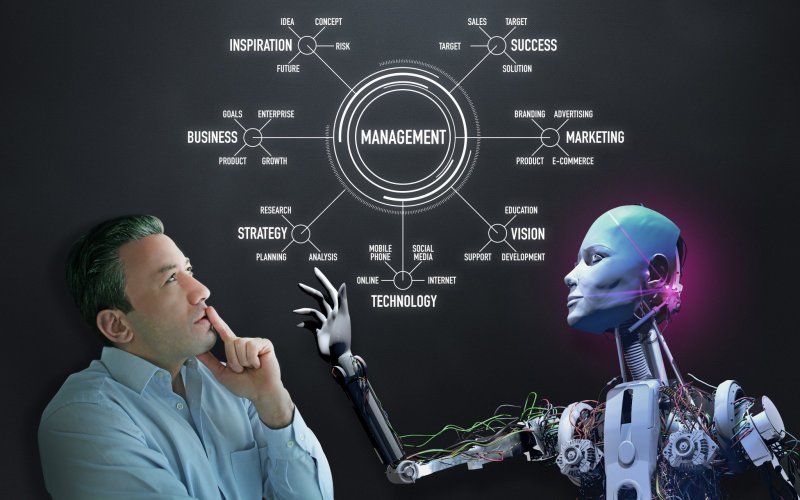
How are you leveraging AI to differentiate your business?
By Rick Lochner • September 28, 2026
...so that you can do something about it now”

By Rick Lochner • August 26, 2026
...it’s the product of their interaction.” While we’ve written intermittently about systems and processes, the current VUCA (Volatile, Uncertain, Comple, Ambiguous) business environment compels us to spend more time on how important systems thinking is to effective leadership. We are using the title quote from the late Russell Ackoff , who was a pioneer in the field of operations research, systems thinking and management science. And to illustrate the importance of the title quote, we will use a case study we came across a year ago to drive the point home. The project was a joint venture between General Motors and Toyota named the New United Motor manufacturing, Inc. or NUMMI for short. The goal of the venture was to apply the lessons Toyota learned around lean manufacturing to a failing GM plant in Fremont, California. The results were dramatic in the increased productivity of the plant proving that transformation could occur with fundamentally the same personnel in the plant before and after the switch. While the application of lean methodologies succeeded in producing much improved results, the lessons learned were ultimately lost on GM leadership. They concluded that it was the processes alone that created the change since the personnel were basically the same. In fact, it was the interrelationships between the processes that carried the success of the venture overall. Today, that plant is owned by Tesla. So, what does that mean in a VUCA business environment? It means that leaders trying to react and flex to pieces and parts of the system that are impacted by change will struggle to solve the problem in a sustainable way. It is understanding that volatility and/or complexity, while deeply affecting one particular part of the system, ultimately has systemic impacts across other systems as well. It also means that uncertainty and/or ambiguity will make it difficult to ascertain where the solution lies without looking at the business through the lens of systems thinking. Now, just for the fun of it, let’s throw in the impact of artificial intelligence (AI). The AI impact has come at the business environment with a vengeance to the point where we are already seeing the strategic and systemic challenges encountered by early adopters. In our estimation, it once again looks like business leaders are adopting AI as a workforce replacement instead of addressing where AI fits into the current and desired systems approach to the business. Once again, the absence of being able to see the interrelationships between systems creates major blind spots and lessons not learned similar to the NUMMI and GM venture. From our 2022 book, “ Finding the Missing Piece : The Impact of Effective Communications on sustainable Success”, we define systems thinking as, “...a holistic approach focusing on how a system’s components work together, how a system operates over time as well as how it operates in the context of other larger systems.” The only way systems can provide the foundational value to the organization is through leaders who can fully appreciate and understand its benefits, especially in a VUCA business environment! How are your leadership interactions enhancing the business systems? If you’re not sure, we can help . Lead Well!