
“If you think you know something...

January 27, 2020

Share this article:

...then it is hard to be open to learning.”


Last month I posted about Dr. Max McKeown’s book, “The Innovator’s Book – Rules for Rebels, Mavericks and Innovators”. In the post, I highlighted a specific page that includes the title quote of this post. I believe it sets up this month’s topic quite nicely as we talk about Strategic Leadership. At the beginning of the calendar year, many businesses, for-profit and non-profit, large corporations and small privately-owned businesses are executing their strategic plans. As we begin yet another calendar/fiscal year, let’s explore what really goes into thinking strategically as a leader in the 21st Century dynamic business environment.


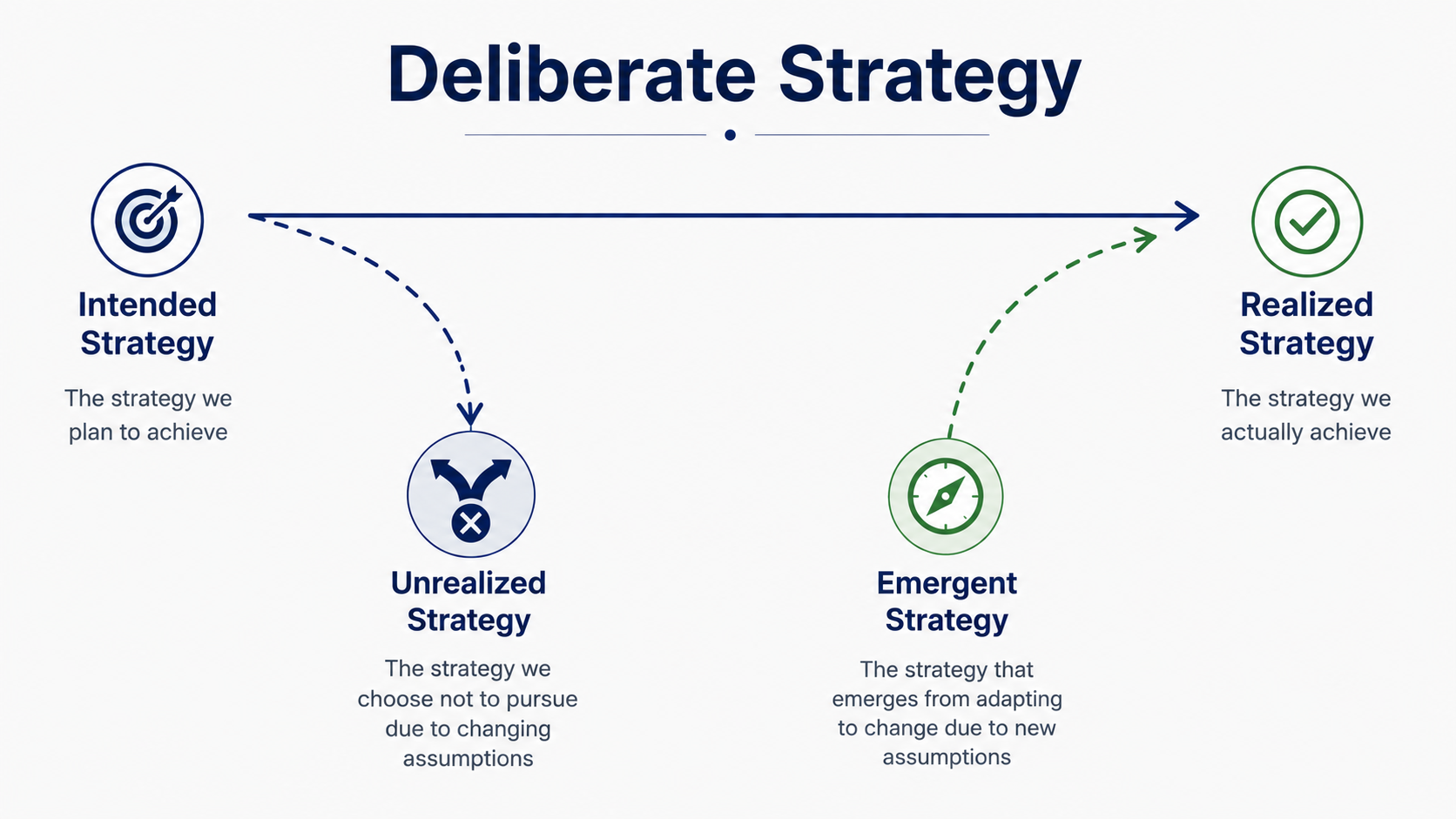
In the past few month’s I’ve given multiple speeches and presentations around these strategic leadership competencies as they are at the core of staying relevant and achieving sustainable success in their businesses. These competencies are based on the research of Kimberly Boal and Robert Hooijberg published in 2009. They suggested that the key competencies that feed strategic leadership effectiveness are; Management Wisdom (synthesize), the Capacity to Absorb (learn) and the Capacity to Change (adapt). Let’s explore each one in more detail.


  • Management Wisdom (Synthesize) ~ No matter what industry or market a business operates in, change in those industries and markets is the norm! It is not a function of “if” change will happen, it’s a matter of how fast it happens. Therefore, strategic leaders always have an eye on the external environment to see how things are changing. They routinely use tools like the PESTEL Analysis and the SWOT Synthesis as well as information provided by trusted sources such as their industry associations to help determine their next move in staying relevant. Effective strategic leaders know this is paramount to sustainable success!


  • The Capacity to Absorb (Learn) ~ Knowing what is happening in one’s business environment means little if leaders cannot learn! History is replete with business failures where the business leaders simply chose to ignore what they saw and maintained the status quo based on what they already knew. The ability to challenge and change one’s beliefs in the face of new industry and market information is crucial to sustainable success. As Alvin Toffler, the author and futurist, said, “The illiterate of the 21st Century will not be the ones who cannot read or write, but those who cannot learn, unlearn and relearn.” Effective strategic leaders are continuous learners!


  • The Capacity to Change (Adapt) ~ Learning new skills to maintain relevance in a dynamic business environment means little if those skills are not applied and exercised! It is why leadership training cannot produce effective leaders without complementary leadership development. An abundance of content without applying the content within the context of the business Vision and Strategy is merely a slow path to irrelevance! General Eric Shinsecki said it best when he said, “If you dislike change, you’re going to dislike irrelevance even less.” Effective strategic leaders know adaptability is the only way to stay relevant!


Sustainable organizational effectiveness is impossible to achieve if the organization’s leaders cannot (or will not) lead strategically! Too much time spent in the day-to-day operations and the Management Wisdom diminishes significantly. If too much time is spent planning and learning about change without active adaption, the business is left behind in their respective markets and industries. Charles Darwin once stated, “It is not the strongest of the species that survive nor the most intelligent, but the one most responsive to change.” Applying all three strategic leadership skills ensures the business achieves sustainable success!


How are you applying new learning to keep your business relevant?


Lead Well!

Follow Us:

Our Latest Insights

By Rick Lochner • October 26, 2026
...by its resiliency in uncertainty”
How are you leveraging AI to differentiate your business?
By Rick Lochner • September 28, 2026
...so that you can do something about it now”

By Rick Lochner • August 26, 2026
...it’s the product of their interaction.” While we’ve written intermittently about systems and processes, the current VUCA (Volatile, Uncertain, Comple, Ambiguous) business environment compels us to spend more time on how important systems thinking is to effective leadership. We are using the title quote from the late Russell Ackoff , who was a pioneer in the field of operations research, systems thinking and management science. And to illustrate the importance of the title quote, we will use a case study we came across a year ago to drive the point home. The project was a joint venture between General Motors and Toyota named the New United Motor manufacturing, Inc. or NUMMI for short. The goal of the venture was to apply the lessons Toyota learned around lean manufacturing to a failing GM plant in Fremont, California. The results were dramatic in the increased productivity of the plant proving that transformation could occur with fundamentally the same personnel in the plant before and after the switch. While the application of lean methodologies succeeded in producing much improved results, the lessons learned were ultimately lost on GM leadership. They concluded that it was the processes alone that created the change since the personnel were basically the same. In fact, it was the interrelationships between the processes that carried the success of the venture overall. Today, that plant is owned by Tesla. So, what does that mean in a VUCA business environment? It means that leaders trying to react and flex to pieces and parts of the system that are impacted by change will struggle to solve the problem in a sustainable way. It is understanding that volatility and/or complexity, while deeply affecting one particular part of the system, ultimately has systemic impacts across other systems as well. It also means that uncertainty and/or ambiguity will make it difficult to ascertain where the solution lies without looking at the business through the lens of systems thinking. Now, just for the fun of it, let’s throw in the impact of artificial intelligence (AI). The AI impact has come at the business environment with a vengeance to the point where we are already seeing the strategic and systemic challenges encountered by early adopters. In our estimation, it once again looks like business leaders are adopting AI as a workforce replacement instead of addressing where AI fits into the current and desired systems approach to the business. Once again, the absence of being able to see the interrelationships between systems creates major blind spots and lessons not learned similar to the NUMMI and GM venture. From our 2022 book, “ Finding the Missing Piece : The Impact of Effective Communications on sustainable Success”, we define systems thinking as, “...a holistic approach focusing on how a system’s components work together, how a system operates over time as well as how it operates in the context of other larger systems.” The only way systems can provide the foundational value to the organization is through leaders who can fully appreciate and understand its benefits, especially in a VUCA business environment! How are your leadership interactions enhancing the business systems? If you’re not sure, we can help . Lead Well!