
Optics...

December 18, 2022

Share this article:

...or Outcomes


Several months ago, I was having a coaching conversation with a client where the conversation went down a path of how a situation looked versus how it was in reality. In that moment, it occurred to me how impactful that concept was to leaders of any organization! To be able to separate perception of how a situation or issue looks or feels from the factual truth about a situation or issue is the level of critical thinking crucial to effective leadership.

As we put these words to paper, most leaders are winding down the current business year and putting the final touches on their plans for the next business year. If they are like our clients, they’ve documented the strategies, operation and tactical successes for the past year. In addition to the summary of success, we press further to have leaders document what they base their successes on. This prevents a success narrative that begins with statements such as, “We feel like we did...”, or ”We think that we accomplished...”, or “It looks like we achieved...”. In our view, these are optics statements that are begging to be challenged with factual validation. As the expression goes, “If you can’t measure it, did it really happen?”!


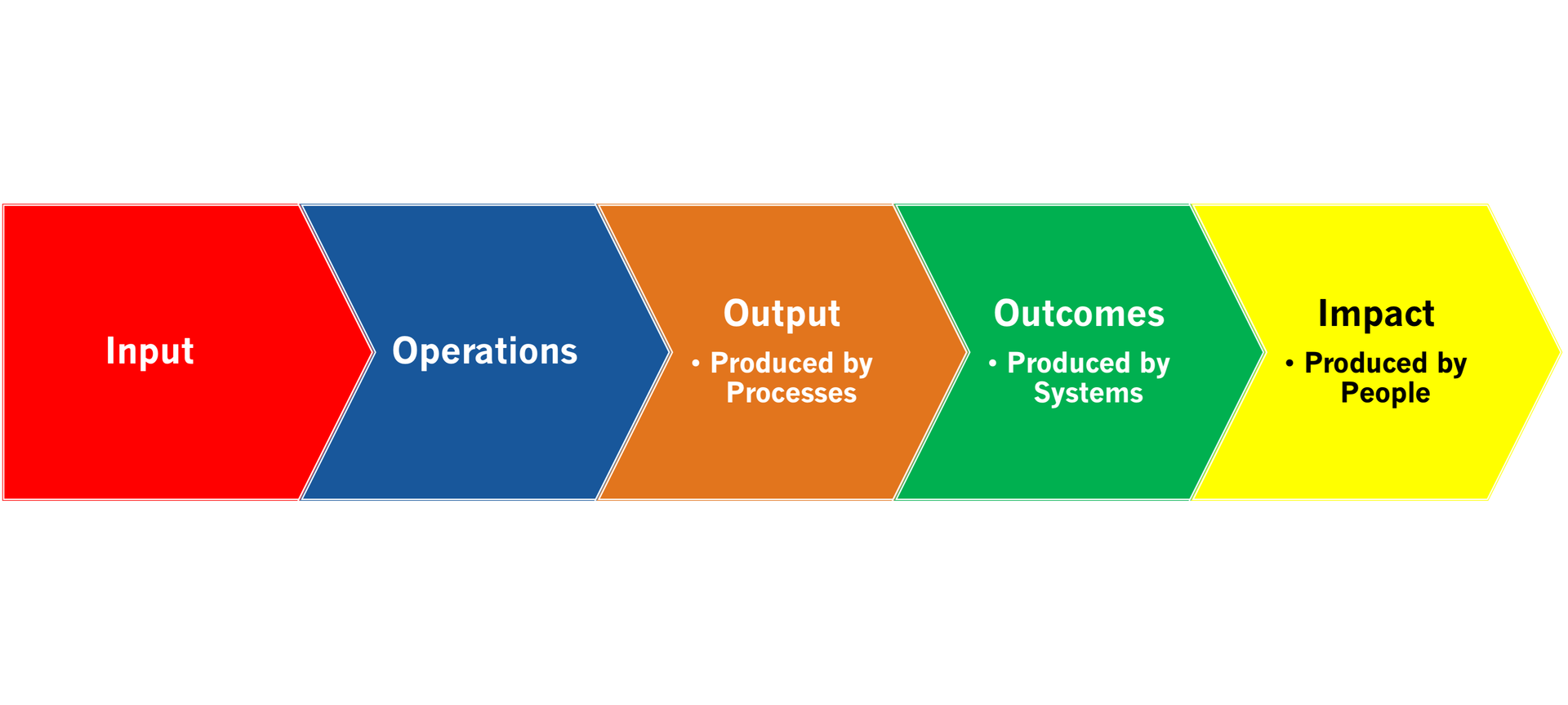
As leaders put their final touches on next year’s strategy, and associated operational and tactical plans, it is important to remember the level of metrics that tell the complete story of organizational success. As a refresher, we look at the multiple layers of metrics that align to produce business impact. At a tactical level, processes produce outputs. When we combine processes into a collection of systems, outcomes are the output of these systems. Finally, when people apply these outcomes through the lens of the organizational vision and mission, then impact happens. Processes produce outputs, systems produce outcomes and people produce impact!


So, as leaders look ahead, they must focus on all the three. When leaders only focus on process outputs, the results of each process are out of alignment with each other creating friction within the system. When development outputs in a non-profit are misaligned with program outputs, systemic outcomes cannot be achieved. When sales outputs are out of alignment with customer service outputs, systemic outcomes cannot be achieved!


This brings us to the importance of systems alignment. If we assume the process outputs are aligned within the systems, leaders must still address the question of impact. What impact are these outcomes having? If you are a non-profit leader of a food bank for instance, what measurable impact is providing food having on the community at large? If you are a leader of a national services organization for example, what measurable impact is providing those services having on the clients and/or communities? The conversation does not stop at outcomes, it ends with how the outcomes are leveraged for sustained impact!


Business alignment is about creating a business narrative giving leaders the ability to communicate success in a tangible and meaningful way. Just because the business feels good or looks good, does not mean it is having the desired impact. That impact can only be a product of measurable outcomes, not optics!


How are your business outcomes creating impact? If you don’t know, we can help!


Lead Well!

Follow Us:

Our Latest Insights

How are you leveraging AI to differentiate your business?
By Rick Lochner • September 28, 2026
...so that you can do something about it now”

By Rick Lochner • August 26, 2026
...it’s the product of their interaction.” While we’ve written intermittently about systems and processes, the current VUCA (Volatile, Uncertain, Comple, Ambiguous) business environment compels us to spend more time on how important systems thinking is to effective leadership. We are using the title quote from the late Russell Ackoff , who was a pioneer in the field of operations research, systems thinking and management science. And to illustrate the importance of the title quote, we will use a case study we came across a year ago to drive the point home. The project was a joint venture between General Motors and Toyota named the New United Motor manufacturing, Inc. or NUMMI for short. The goal of the venture was to apply the lessons Toyota learned around lean manufacturing to a failing GM plant in Fremont, California. The results were dramatic in the increased productivity of the plant proving that transformation could occur with fundamentally the same personnel in the plant before and after the switch. While the application of lean methodologies succeeded in producing much improved results, the lessons learned were ultimately lost on GM leadership. They concluded that it was the processes alone that created the change since the personnel were basically the same. In fact, it was the interrelationships between the processes that carried the success of the venture overall. Today, that plant is owned by Tesla. So, what does that mean in a VUCA business environment? It means that leaders trying to react and flex to pieces and parts of the system that are impacted by change will struggle to solve the problem in a sustainable way. It is understanding that volatility and/or complexity, while deeply affecting one particular part of the system, ultimately has systemic impacts across other systems as well. It also means that uncertainty and/or ambiguity will make it difficult to ascertain where the solution lies without looking at the business through the lens of systems thinking. Now, just for the fun of it, let’s throw in the impact of artificial intelligence (AI). The AI impact has come at the business environment with a vengeance to the point where we are already seeing the strategic and systemic challenges encountered by early adopters. In our estimation, it once again looks like business leaders are adopting AI as a workforce replacement instead of addressing where AI fits into the current and desired systems approach to the business. Once again, the absence of being able to see the interrelationships between systems creates major blind spots and lessons not learned similar to the NUMMI and GM venture. From our 2022 book, “ Finding the Missing Piece : The Impact of Effective Communications on sustainable Success”, we define systems thinking as, “...a holistic approach focusing on how a system’s components work together, how a system operates over time as well as how it operates in the context of other larger systems.” The only way systems can provide the foundational value to the organization is through leaders who can fully appreciate and understand its benefits, especially in a VUCA business environment! How are your leadership interactions enhancing the business systems? If you’re not sure, we can help . Lead Well!
Green road signs labeled “LEADER” left and “FOLLOWER” right on a pole
By Rick Lochner • July 26, 2026
This is a question every leader of any business (for profit or non-profit) of any size and any industry or market needs to regularly ask themselves. It is a critical question in that it establishes the very reason a leader earns the privilege of being called a leader.