
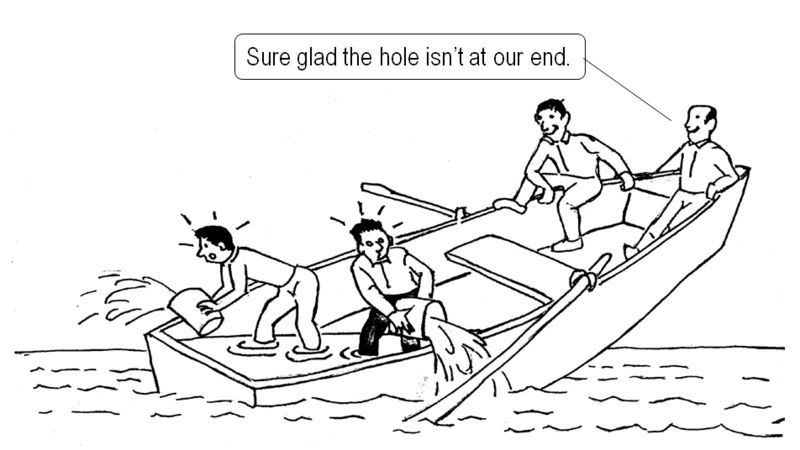
Accountability is the glue...

April 29, 2024

Share this article:

...that ties commitment to the final result.”


This month’s discussion is inspired in part by recent events in the world of sports. We recently witnessed exciting college basketball final four tournaments with the women’s tournament setting overall viewership records. We also watched the NFL draft as 32 professional football teams take steps to predict and perfect their team’s future success. With that in mind, we turn our thoughts to a much-discussed topic in our leadership and business coaching practice: accountability.

To quote a post that has made the rounds on social media (original author unknown) and goes:


Bad teams are not held accountable.

Good teams are held accountable by the coach.

Championship teams are held accountable by each other.


It aligns quite nicely with our definition of a team as, “A group of people brought together to use their complementary skills to achieve a common purpose for which they hold themselves collectively accountable.” It is the last point on collective accountability that is the essence of what separates the top performing teams from the rest in both sports and business.


We also define accountability as an “attitude of ownership” in whatever the leader says, does, decides, etc. it differs from responsibility in that responsibility is focused on tasks and actions while accountability is people focused. So, let’s break down the earlier quote in the business team context.


  • Bad teams are not held accountable ~ Individually, very few people show up to work to consciously make mistakes or fail in their job. Yet, when mistakes do happen (and they always will) those same individuals will look to others to blame or deflect the blame for their mistake. When leaders allow this behavior to linger, it is the sure sign of a bad team. Favoritism, poor goals and expectations and constant unresolved conflict are all signs that the leader is leading a dysfunctional team or not a team at all. As the expression goes, “The culture is only as good as the worst behavior the leader tolerates.”
  • Good teams are held accountable by the coach ~ In a business sense, a team that depends on their team leader for accountability, regardless of what level in the organization they manage, may also not be a team. Often times, business groups better fit this description. That is not to say groups are any less effective than teams, they just do so in a different context. In the same manner that we defined a team earlier, we define a group as, “Two or more individuals, interacting and interdependent, who have come together to achieve particular objectives.” Notice this definition does not include collective accountability. Rather the accountability comes from the group leader and is focused more on an individual one-on-one basis and sometimes with the group as a whole.
  • Championship teams are held accountable by each other ~ Three of my favorite sports coaches who promote team accountability and achieved championship status are recently retired Nick Saban of Alabama football fame, Mike Krzyzewski of Duke men’s basketball fame and the late Pat Summit of Tennessee women’s basketball fame. While collective accountability sounds like a great idea, it is very difficult to achieve. According to Gordy Curphy of Curphy Leadership Solutions, only 20 percent of business teams are high performing. One of the biggest challenges is the team holding themselves accountable to a set of goals expectations and norms that are agreed to by the entire team in both words and actions.


The title quote of this discussion from Bob Proctor sets the stage for the ongoing importance of true accountability on every business team. In my past leadership roles, I’ve had the opportunity to lead what I would consider two high performing teams by any measure. What made these two teams special is their desire to self-manage and lean on each other for the good of the entire team above themselves. That is what true collective accountability means and is the secret to achieving desired results and sustainable success as a team!

How is your team holding themselves accountable to win? If you are not sure, we can help!


Lead Well!

Follow Us:

Our Latest Insights

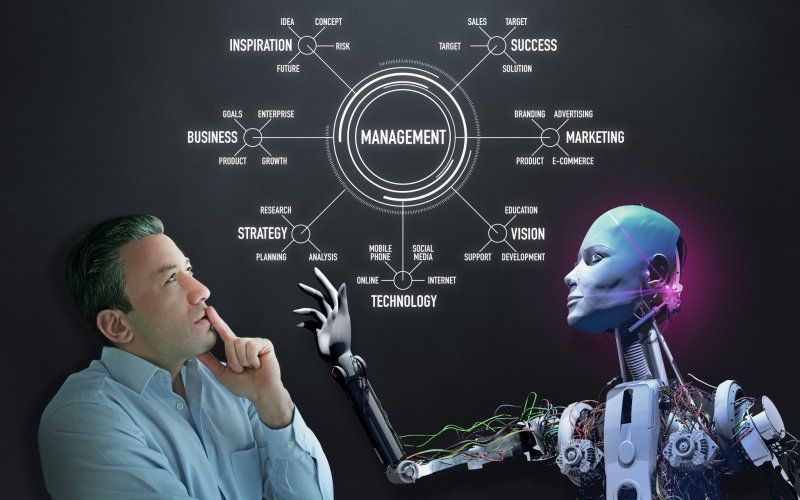
How are you leveraging AI to differentiate your business?
By Rick Lochner • September 28, 2026
...so that you can do something about it now”

By Rick Lochner • August 26, 2026
...it’s the product of their interaction.” While we’ve written intermittently about systems and processes, the current VUCA (Volatile, Uncertain, Comple, Ambiguous) business environment compels us to spend more time on how important systems thinking is to effective leadership. We are using the title quote from the late Russell Ackoff , who was a pioneer in the field of operations research, systems thinking and management science. And to illustrate the importance of the title quote, we will use a case study we came across a year ago to drive the point home. The project was a joint venture between General Motors and Toyota named the New United Motor manufacturing, Inc. or NUMMI for short. The goal of the venture was to apply the lessons Toyota learned around lean manufacturing to a failing GM plant in Fremont, California. The results were dramatic in the increased productivity of the plant proving that transformation could occur with fundamentally the same personnel in the plant before and after the switch. While the application of lean methodologies succeeded in producing much improved results, the lessons learned were ultimately lost on GM leadership. They concluded that it was the processes alone that created the change since the personnel were basically the same. In fact, it was the interrelationships between the processes that carried the success of the venture overall. Today, that plant is owned by Tesla. So, what does that mean in a VUCA business environment? It means that leaders trying to react and flex to pieces and parts of the system that are impacted by change will struggle to solve the problem in a sustainable way. It is understanding that volatility and/or complexity, while deeply affecting one particular part of the system, ultimately has systemic impacts across other systems as well. It also means that uncertainty and/or ambiguity will make it difficult to ascertain where the solution lies without looking at the business through the lens of systems thinking. Now, just for the fun of it, let’s throw in the impact of artificial intelligence (AI). The AI impact has come at the business environment with a vengeance to the point where we are already seeing the strategic and systemic challenges encountered by early adopters. In our estimation, it once again looks like business leaders are adopting AI as a workforce replacement instead of addressing where AI fits into the current and desired systems approach to the business. Once again, the absence of being able to see the interrelationships between systems creates major blind spots and lessons not learned similar to the NUMMI and GM venture. From our 2022 book, “ Finding the Missing Piece : The Impact of Effective Communications on sustainable Success”, we define systems thinking as, “...a holistic approach focusing on how a system’s components work together, how a system operates over time as well as how it operates in the context of other larger systems.” The only way systems can provide the foundational value to the organization is through leaders who can fully appreciate and understand its benefits, especially in a VUCA business environment! How are your leadership interactions enhancing the business systems? If you’re not sure, we can help . Lead Well!
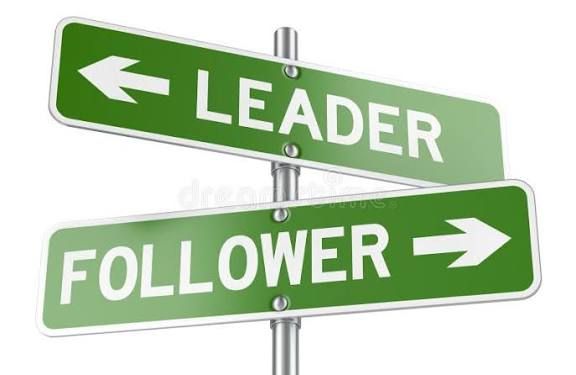
Green road signs labeled “LEADER” left and “FOLLOWER” right on a pole
By Rick Lochner • July 26, 2026
This is a question every leader of any business (for profit or non-profit) of any size and any industry or market needs to regularly ask themselves. It is a critical question in that it establishes the very reason a leader earns the privilege of being called a leader.