
“Action and Adaptability...

September 25, 2020

Share this article:

...create Opportunity.”


At the risk of sounding redundant and a little like Captain Obvious, the new reality challenged every leader’s script for success. It reminds me of a term from my former life, VUCA which is an acronym for Volatility, Uncertainty, Complexity and Ambiguity. It was coined by the Army War College in the late 1980s as part of post-Cold War planning discussions. There is little doubt today’s 21st Century business environment encompasses all of these conditions!


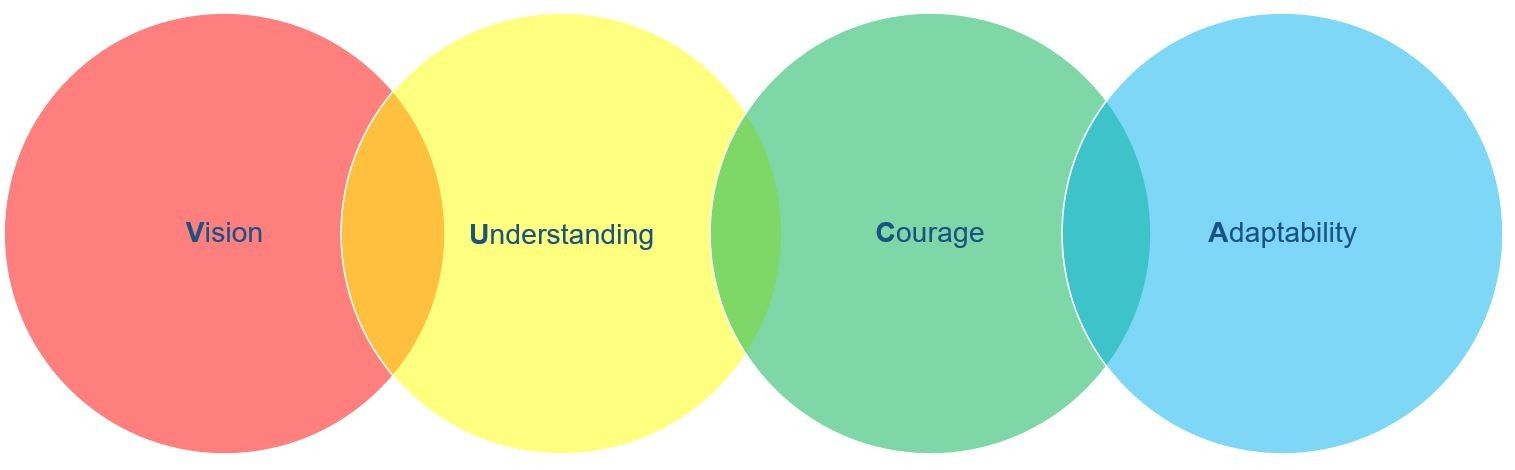
Instead of dwelling on each of these conditions and their impact on leadership, let’s look forward and see how today’s leaders can create opportunity as motivational speaker Garrison Wynn suggests in the title quote. By way of structure, we will use the VUCA 2.0 Model coined by former Medtronic CEO Bill George. He simply redefined the original letters in the acronym to now mean Vision, Understanding, Courage and Adaptability. Let’s explore each in more detail:


  • Vision ~ Vision is defined as the creation of a future view for the organization. It is an intended future clear enough to the organization that people collectively know the direction and outcome of the work it does. It is a key element in the strategic thinking process that also includes Values, Mission and Strategy all created and executed in the context of the desired organizational culture. A clear vision allows everyone in the organization to see through the morass of VUCA and remain focused on the desired outcome on the other side of the new reality!


  • Understanding ~ “How well do you know your industry? How well do you really know your business?” When times are good and steady, these questions are much easier to answer than in a VUCA world. However, they are quite relevant in the new reality as leaders must navigate the context of the new reality and what it means to their business and organization. There is a reason that some businesses thrive in a VUCA world and not because they are fortunate enough to sell a product or service naturally needed in the new reality. It is because their leaders understand their industry and business well enough to see new opportunities to pivot toward and/or new ways to leverage what they already have. They are the critical thinkers, listeners and challengers who are comfortable being uncomfortable!


  • Courage ~ Knowing without acting is a recipe for opportunities missed! Just because leaders are aware of, and know what needs to change, does not mean success in and by itself. Success if based on action and action in a VUCA world takes courage. Every leader manages the inner voice that is saying, “What if we’re wrong?” or something along those lines. Those leaders with courage have the courage and confidence to move forward and keep the doubts in check, even when some in the organization itself may be saying the same things. Courageous leaders know that coping is not good enough and that flexing forward is always the right strategy!


  • Adaptability ~ Being flexible is reacting in real time to new situations whereas adaptability is the ability to be proactive over the long haul in a sustainable way. It is why, in my own corporate leadership career, the end goal was always an adaptable culture. Being flexible is a good tactical skill set whereas adaptability is a strategic attitude. In less than two months after the pandemic lockdown, we were challenging leaders on what they had learned about themselves and their organizations and what opportunities they were looking to pursue!


Opportunity is defined in Dictionary.com as “an appropriate or favorable time or occasion; a situation or condition favorable for attainment of a goal; a good position, chance, or prospect, as for advancement or success.” It may seem strange to use words like “favorable time” and “good position...for success.” in today’s new reality. Those leaders who view the new reality through the VUCA lens are more focused on coping and surviving. However, when leaders frame the new reality through the VUCA 2.0 lens, they see opportunity. They see a future of success where the culture of the organization embraces adaptability based on collective understanding of the business climate and the courage to keep moving forward!


What new opportunities are you taking advantage of? If you don't know, we can help.


Lead Well!

Follow Us:

Our Latest Insights

By Rick Lochner • October 26, 2026
...by its resiliency in uncertainty”
How are you leveraging AI to differentiate your business?
By Rick Lochner • September 28, 2026
...so that you can do something about it now”

By Rick Lochner • August 26, 2026
...it’s the product of their interaction.” While we’ve written intermittently about systems and processes, the current VUCA (Volatile, Uncertain, Comple, Ambiguous) business environment compels us to spend more time on how important systems thinking is to effective leadership. We are using the title quote from the late Russell Ackoff , who was a pioneer in the field of operations research, systems thinking and management science. And to illustrate the importance of the title quote, we will use a case study we came across a year ago to drive the point home. The project was a joint venture between General Motors and Toyota named the New United Motor manufacturing, Inc. or NUMMI for short. The goal of the venture was to apply the lessons Toyota learned around lean manufacturing to a failing GM plant in Fremont, California. The results were dramatic in the increased productivity of the plant proving that transformation could occur with fundamentally the same personnel in the plant before and after the switch. While the application of lean methodologies succeeded in producing much improved results, the lessons learned were ultimately lost on GM leadership. They concluded that it was the processes alone that created the change since the personnel were basically the same. In fact, it was the interrelationships between the processes that carried the success of the venture overall. Today, that plant is owned by Tesla. So, what does that mean in a VUCA business environment? It means that leaders trying to react and flex to pieces and parts of the system that are impacted by change will struggle to solve the problem in a sustainable way. It is understanding that volatility and/or complexity, while deeply affecting one particular part of the system, ultimately has systemic impacts across other systems as well. It also means that uncertainty and/or ambiguity will make it difficult to ascertain where the solution lies without looking at the business through the lens of systems thinking. Now, just for the fun of it, let’s throw in the impact of artificial intelligence (AI). The AI impact has come at the business environment with a vengeance to the point where we are already seeing the strategic and systemic challenges encountered by early adopters. In our estimation, it once again looks like business leaders are adopting AI as a workforce replacement instead of addressing where AI fits into the current and desired systems approach to the business. Once again, the absence of being able to see the interrelationships between systems creates major blind spots and lessons not learned similar to the NUMMI and GM venture. From our 2022 book, “ Finding the Missing Piece : The Impact of Effective Communications on sustainable Success”, we define systems thinking as, “...a holistic approach focusing on how a system’s components work together, how a system operates over time as well as how it operates in the context of other larger systems.” The only way systems can provide the foundational value to the organization is through leaders who can fully appreciate and understand its benefits, especially in a VUCA business environment! How are your leadership interactions enhancing the business systems? If you’re not sure, we can help . Lead Well!